
By the Blue Daisy Lawn Care team · Central Florida
The single most common mistake Central Florida homeowners — and many lawn crews — make is mowing too low. It seems counterintuitive: cut lower and mow less often, right? In reality, cutting below the recommended height for your grass type creates a chain of problems that costs far more to fix than the mowing savings are worth.
According to UF/IFAS Extension (gardeningsolutions.ifas.ufl.edu), mowing at the correct height is one of the most important things you can do for your lawn's health. Here's why — and exactly what the right height is for every major Florida grass type.
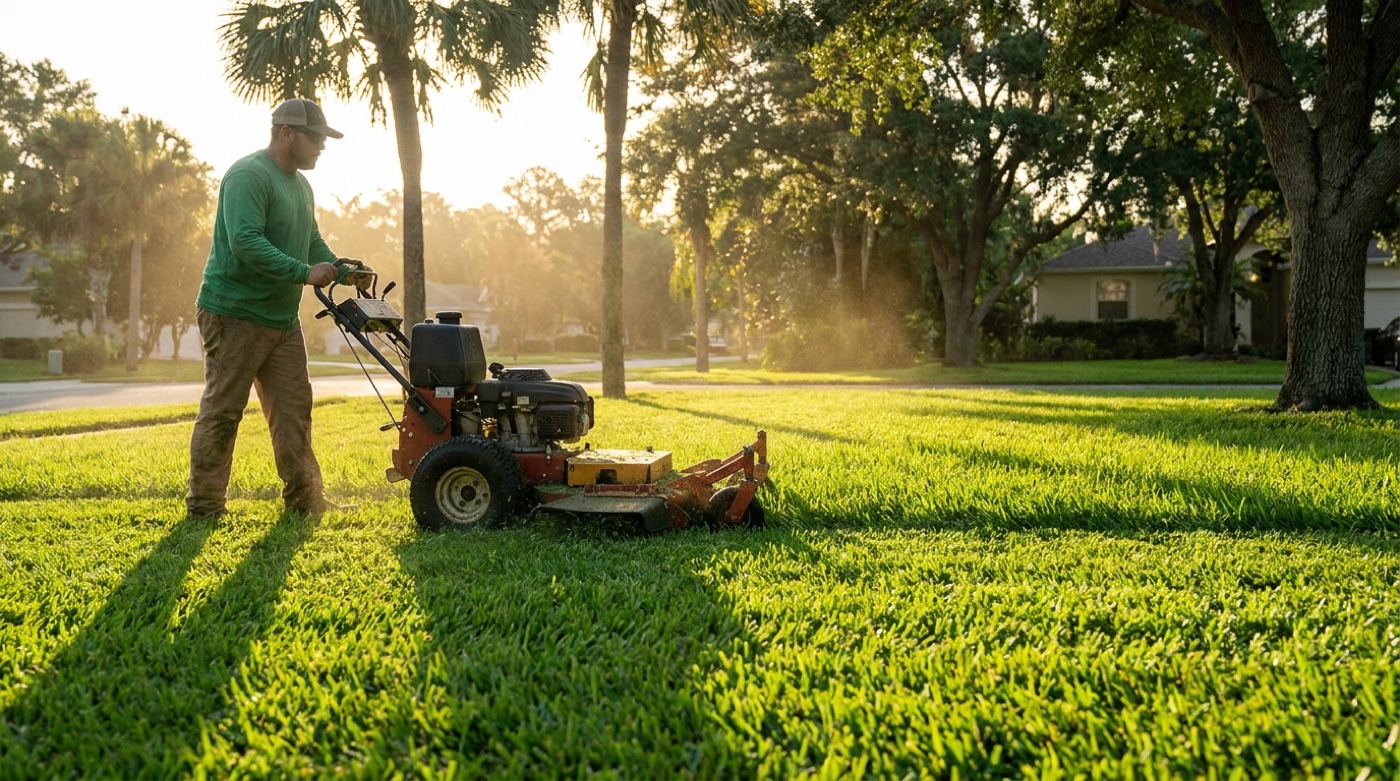
The One-Third Rule: The Most Important Mowing Principle
UF/IFAS Extension states this plainly: never remove more than one-third of the leaf blade height in any single mowing event. Violating this rule — commonly called scalping — creates immediate stress on the turf that can take weeks to months to recover from in Florida's heat.
Here's how the rule works in practice: if you are maintaining St. Augustinegrass (Floratam) at 3.5 inches, you should mow it when it reaches approximately 5.25 inches. At that point, removing one-third brings it back to 3.5 inches. If you let it grow to 6 or 7 inches before mowing, cutting back to 3.5 inches removes more than one-third — and the lawn is scalped.
The consequence of scalping in the Florida summer is not just cosmetic. Removing too much blade at once:
- Exposes the stolons and crown to direct sunlight, causing sunscald and dramatically weakening the plant
- Reduces root depth because the root system follows the leaf surface — shorter leaves mean shallower roots
- Creates entry points for fungal diseases like large patch and gray leaf spot
- Opens the soil surface to sunlight, allowing dormant weed seeds to germinate in the scalped areas
A single scalping event in Central Florida's summer heat can kill a large patch of St. Augustine — particularly in areas that were already under stress from heat or drought. Recovery requires weeks of correct care, and in some cases partial re-sodding.
Mowing Height Reference: Every Major Florida Grass Type
The following heights are sourced from UF/IFAS Extension's mowing guide for Florida lawns (gardeningsolutions.ifas.ufl.edu/lawns/maintenance-and-care/mowing-your-florida-lawn/).
| Grass Type | Recommended Mowing Height | Key Notes |
|---|---|---|
| Bahiagrass | 3.0–4.0 inches | Very tough stems — sharp blade is critical; mow when active growth dictates |
| Bermudagrass (common) | 1.0–2.0 inches | Fast-growing; full sun only; requires frequent mowing in growing season |
| Bermudagrass (hybrid: TifTuf, Celebration) | 0.5–1.5 inches | Lower cut required; sharp blade essential; rotary mower leaves acceptable |
| Centipedegrass | 1.5–2.0 inches | Low-maintenance; uncommon in Central FL residential yards |
| St. Augustinegrass (Floratam) | 3.5–4.0 inches | The most common Central FL grass; never cut below 3.5" |
| St. Augustinegrass (dwarf: Seville, Jade, Palmetto) | 2.5–3.0 inches | More shade-tolerant; lower growth habit than Floratam |
| ProVista St. Augustine | 3.0–4.0 inches (best at 3.5") | Slower vertical growth = less frequent mowing; 3.5" maximizes weed suppression |
| Zoysiagrass (Empire, Zenith, JaMur) | 1.75–2.5 inches | High silica content — sharp blade critical; thatch management required |
| Zoysiagrass (fine: Zeon, Emerald) | 0.5–1.5 inches | Reel mower preferred; very precise cut required at this height |
The Hidden Problem: Dull Mower Blades
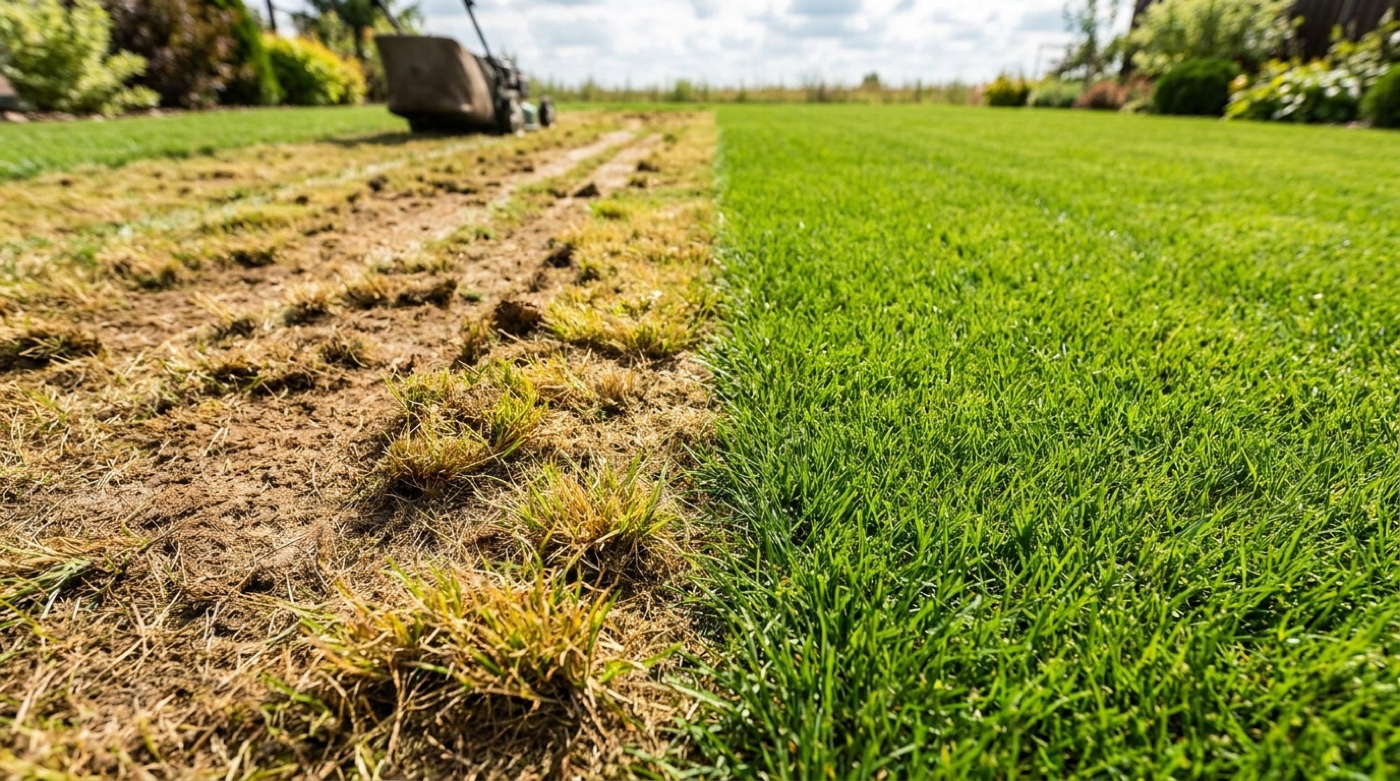
Even if your mowing height is correct, a dull blade does significant damage. UF/IFAS Extension specifically notes that mowing with a dull blade creates tears rather than clean cuts in the grass leaf. Torn tissue:
- Dehydrates faster in Florida's heat, causing brown-tipped blades that are often misdiagnosed as drought stress or disease
- Creates open wounds that allow fungal spores — gray leaf spot, large patch — to enter the plant more easily
- Gives Bahiagrass and Zoysia a ragged, unkempt appearance because their tougher stems require a particularly sharp edge to cut cleanly
Mower blades should be sharpened at least once per season for a typical homeowner lawn, and more frequently for commercial routes or properties with high cutting frequency during peak growing season. A sharp blade is a cheap insurance policy against unnecessary turf damage.
Why You Should Never Mow Wet Grass
UF/IFAS Extension cautions against mowing wet turf with a rotary mower because wet clippings clog the mower deck and can cause uneven cuts. But there's a more serious reason to avoid it: wet clippings are ideal transport vehicles for fungal spores.
If your lawn has any level of large patch or gray leaf spot activity — and during Central Florida's wet season many lawns do — mowing wet grass spreads fungal material across the entire lawn surface with every pass. What might have been a contained spot becomes a lawn-wide outbreak. This is also why professional crews should never mow a diseased lawn without cleaning their equipment before moving to the next property. (See our article on how cheap lawn services spread disease for more on this topic.)
Correct Mowing Height Is Your Best Free Weed Control
This deserves emphasis because it's genuinely underappreciated: maintaining your lawn at the correct height is one of the most effective weed suppression tools available — and it costs nothing extra.
A St. Augustine or ProVista lawn maintained at 3.5 inches develops a dense canopy that shades the soil surface. Weed seeds — crabgrass, dollarweed, spurge, and others — require sunlight to germinate. When the canopy is thick enough to block that sunlight, germination rates drop dramatically. The lawn essentially out-competes weeds by occupying the space weeds would otherwise fill.
Conversely, a lawn mowed at 2.5 inches when the recommended height is 3.5 inches has a thinner canopy, reduced root depth, and significantly more exposed soil. That's the environment where weeds establish most aggressively — and where no herbicide program can fully compensate for the mechanical disadvantage created by the wrong mowing height.
Mowing and Fertilization Are a System
Correct mowing height and a proper fertilization schedule work together. Fertilizing a lawn that's being mowed too low is a partial investment — the turf can't fully utilize the nutrients without adequate leaf surface area. See our guide on lawn fertilization timing in Florida to understand how both practices reinforce each other.
If you are currently using a lawn service and your grass consistently looks thin, pale, or overrun with weeds despite regular mowing, the first thing to check is the mowing height setting. Ask your crew what height they're cutting at — and verify it matches the recommended height for your specific grass type.
Blue Daisy Lawn Care's monthly lawn maintenance service is built around mowing at the correct height for your turf type every visit, with sharp blades, and only when conditions allow it — not just on a calendar that ignores what the grass actually needs. Request a free estimate to find out what your yard's specific needs are.
Get Mowing Done Right
Blue Daisy mows at the correct height for your grass type, with sharp equipment, and follows the one-third rule every visit. Get your free estimate or call (787) 671-2771.