
By the Blue Daisy Lawn Care team · Central Florida
Trees are the longest-term investment in any Central Florida landscape. Plant the wrong species, put it in the wrong spot, or — as happens far too often with crape myrtles — prune it incorrectly for years, and you've set back your yard's value and aesthetics for a decade. Plant the right tree in the right location, and it returns shade, beauty, wildlife habitat, and real property value for generations.
Central Florida sits in USDA Hardiness Zones 9a to 9b, which means we have the heat and humidity to support a wide variety of trees — both native and adapted non-native species. Here's a practical breakdown of the best options for residential yards in Clermont, Haines City, Davenport, and the surrounding Lake and Polk County area.
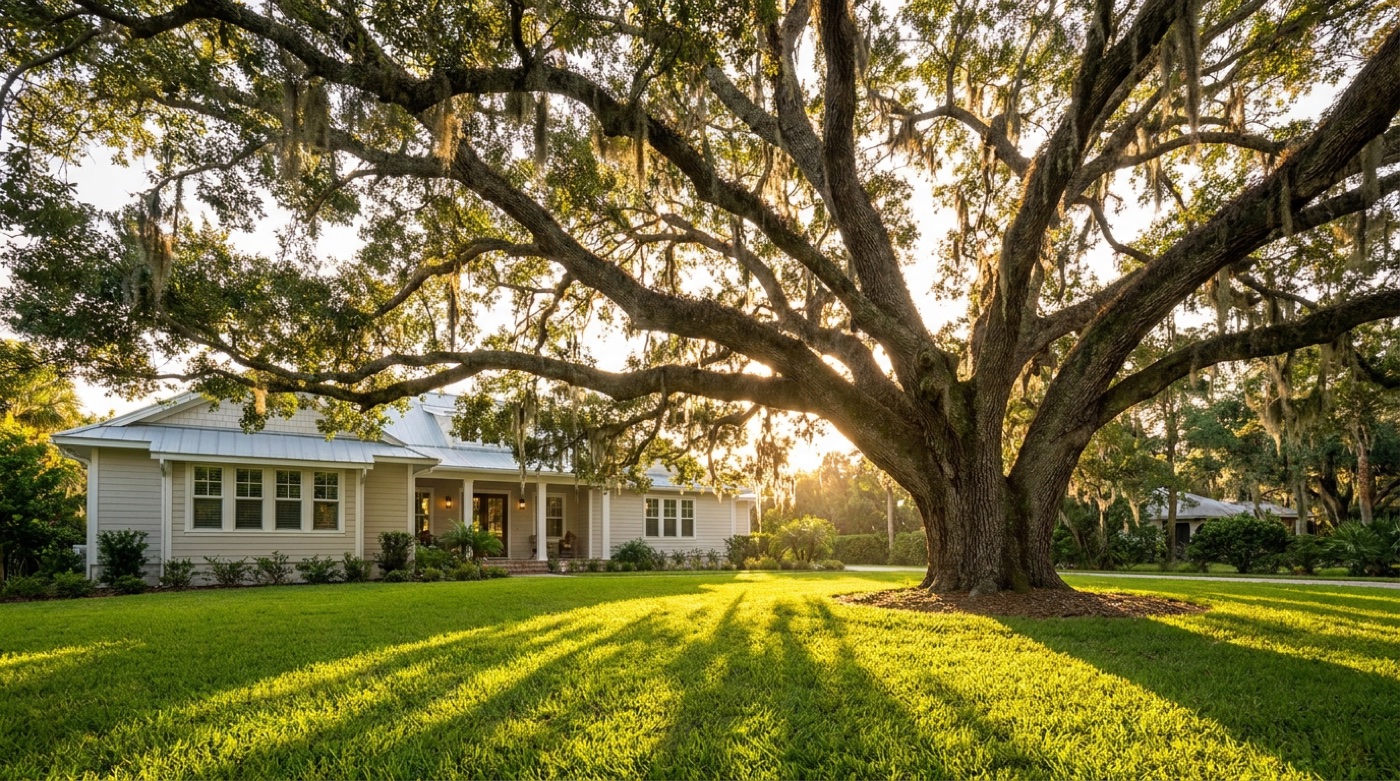
Live Oak (Quercus virginiana)
The live oak is arguably the most valuable tree you can plant in a Central Florida yard — for your property, for the local ecosystem, and for your energy bill. It is a native Florida tree that, once established, is exceptionally drought-tolerant and extremely long-lived, with individual specimens routinely reaching hundreds of years of age.
Live oaks grow 40–60 feet tall with an equally wide canopy spread. They are semi-evergreen: they briefly drop their leaves in early spring as new growth emerges, which surprises homeowners who expect a clean evergreen year-round. The dense summer canopy provides meaningful shade that can reduce cooling costs on the shaded side of a home.
Placement note: Live oak's surface root system can lift pavers, sidewalks, and driveways over time. Plan placement at least 15–20 feet from any paved surface, and never plant directly over irrigation lines or utility runs. This tree needs room — it is not a small-lot option.
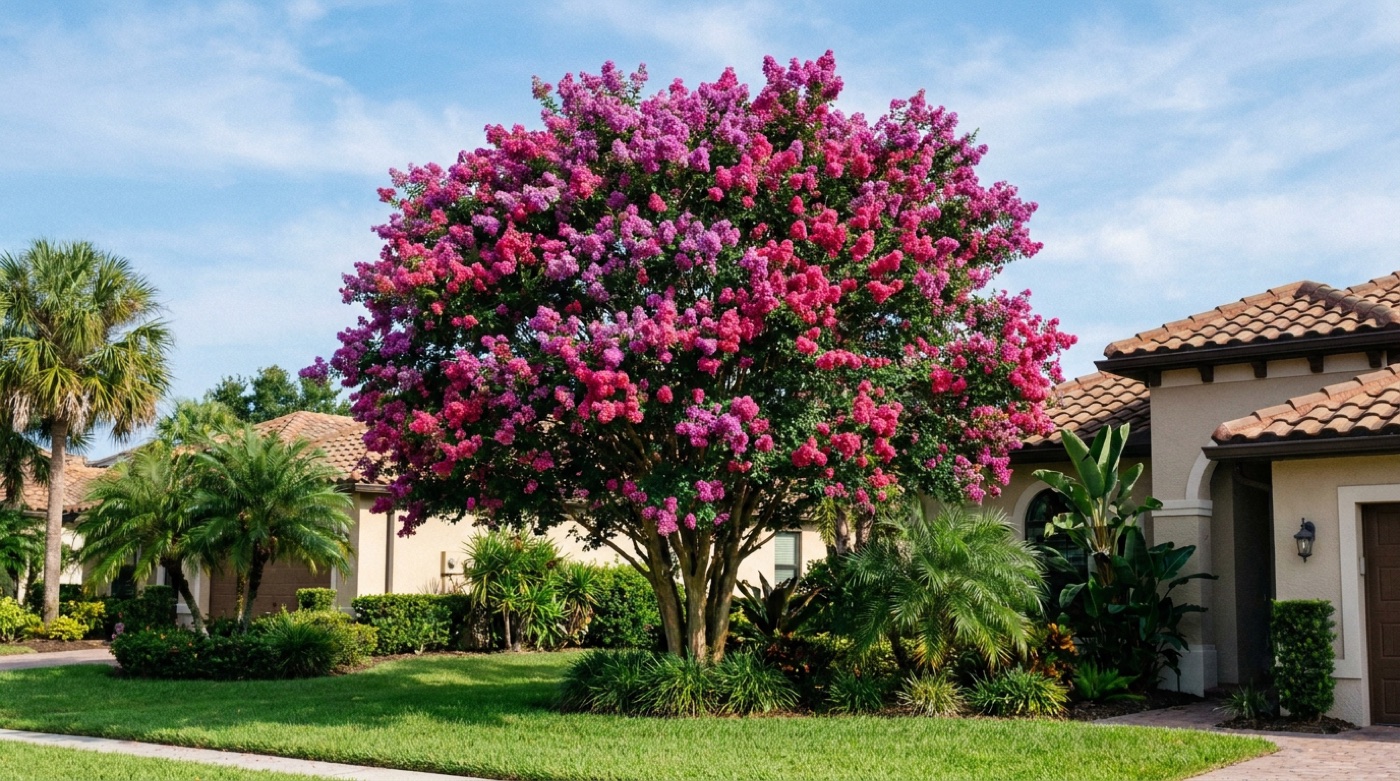
Crape Myrtle (Lagerstroemia spp.): Beautiful, but Please Don't Top It
Crape myrtle is not native to Florida, but it is one of the most well-adapted ornamental trees available in Central Florida's climate. It produces spectacular summer blooms in pink, red, white, and purple that last 60–90 days, and it is genuinely drought-tolerant once established.
Multiple sizes exist — from dwarf varieties that stay under 5 feet to standard trees that reach 25–30 feet — so choosing the right cultivar for your space is important. According to UF/IFAS Extension (blogs.ifas.ufl.edu/orangeco), crape myrtle thrives in Central Florida's USDA Zone 9 conditions with minimal fertilizer needs and good drought tolerance once the root system is established.
What Is "Crape Murder" and Why You Must Avoid It
The practice of severely topping crape myrtles — cutting the main trunks back to thick stubs each winter — is called "crape murder" by horticulturalists for good reason. It destroys the tree's natural branching structure, permanently deforms the tree's silhouette, stimulates excessive weak regrowth, and increases disease susceptibility. Proper crape myrtle care involves selective pruning only: remove crossing branches, thin interior growth slightly, and clean up the base. Never cut back to stubs.
Southern Magnolia (Magnolia grandiflora)
Southern magnolia is a native tree that makes a dramatic visual statement: large, fragrant white flowers from spring through summer, and glossy, deep-green evergreen leaves that give the tree year-round structure. Mature specimens can reach 60–80 feet, making this a tree for large properties with long time horizons.
Magnolias require well-drained soil and won't tolerate wet feet. They're heat-tolerant and do well in Central Florida's climate. The one consistent practical issue: magnolias drop their large, leathery leaves continuously. If you have a pool, placing a magnolia upwind of it means constant skimming. Plan placement with the leaf drop pattern in mind.
Sabal Palm / Cabbage Palm (Sabal palmetto)
Florida's state tree and one of the most Florida-appropriate landscape choices available. The sabal palm is highly wind-resistant — it has survived Category 4 and 5 hurricanes along the Gulf Coast by virtue of its flexible trunk and frond structure. It is drought-tolerant, salt-tolerant, and genuinely low maintenance once established. Mature specimens reach 40–70 feet.
The boot issue: Sabal palms naturally retain the bases of old fronds, called "boots," on their trunk as they grow. Some homeowners and landscapers remove these aggressively for a smooth-trunked aesthetic. Over-removal damages the trunk and removes protective tissue. The best practice is either to leave the natural boot skirt intact or to have trained professionals carefully remove them — not to strip the trunk aggressively.
Robellini / Pygmy Date Palm (Phoenix roebelenii)
The robellini is a small-scale palm, typically reaching 6–10 feet, with graceful feathery fronds and a refined tropical appearance. It is excellent for entryways, flanking front doors, and smaller landscape beds where a full-sized palm would overwhelm the space. It also adapts well to container planting on patios and pool decks.
The robellini is not as cold-hardy as the sabal palm — it can suffer damage in rare Central Florida freeze events below 32°F. In most Clermont and Haines City winters this isn't a practical concern, but it's worth noting for placement in lower-lying, frost-pocket areas. It requires good drainage and moderate water once established.
Jacaranda (Jacaranda mimosifolia)
The jacaranda is not native to Florida, but it is one of the most visually spectacular trees you can plant in Central Florida. In spring, it produces an extraordinary display of purple-blue flower clusters that cover the entire canopy before the leaves fully emerge. The ground beneath a blooming jacaranda turns into a purple carpet — a genuine showpiece for any yard.
Jacarandas are fast-growing and reach 25–40 feet. They are not reliably cold-hardy in colder winters but perform well through most Central Florida winters in the Haines City, Clermont, and Davenport area. They prefer full sun and well-drained soil, and are moderately drought-tolerant once established. During the bloom season, the fallen flowers are messy near driveways and walkways — consider placement accordingly.
Tree Placement: What Most Homeowners Overlook
The most common tree-planting mistake in Central Florida is planting too close to structures, driveways, or utility lines. Young trees look small, and it's easy to underestimate their mature canopy spread. As a general rule:
- Large trees (live oak, magnolia): minimum 20 feet from foundations, driveways, and underground utilities
- Medium trees (crape myrtle, jacaranda): minimum 10–15 feet from structures; choose cultivar size to match the space
- Palms: typically more forgiving of close placement due to non-expanding trunk, but still allow 5–8 feet from structures for sabal palms
- Never plant under existing overhead utility lines — the eventual conflict between the tree and the line is avoidable
Getting tree selection and placement right from the start saves expensive removal costs later. If you're planning a landscape refresh that includes new trees, our landscape design service and tree and palm service can help you choose the right specimens and place them correctly for long-term success. You can also read our companion guide on low-maintenance plants and flowers for Central Florida landscaping to fill in the plant beds around your trees.
Plan Your Landscape with the Right Trees
Blue Daisy Lawn Care provides landscape design and tree and palm service across Haines City, Clermont, Davenport, and Four Corners. Request a free estimate or call (787) 671-2771.